Showing posts with label history of pie. Show all posts

Monday, July 13, 2015

Blueberry Pie

Blueberry Pie in Cast Iron Skillet with Slice

Blueberry pie has long had a place on 4th of July menus. It's an American classic, for one, particularly in the North. A recipe appears in Fannie Farmer's 1896 Boston Cooking-School Cook Book (though strangely calling for six de-seeded green grapes to improve flavor) and is the state dessert of Maine (though wild low-bush berries are the standby there). 

The timing also aligns-- the little blue berries (or blue bellies as I called them when I was little) generally ripen shortly after the first day of summer. Food Timeline's 4th of July Food History, blueberry pie is prescribed on Good Housekeeping's suggested menus of both 1949 and 1955, in the latter to be served with "Spiced Sour Cream and Hot Coffee (instant)." 

Blueberry Pie in Cast Iron Skillet

This year a deep-dish blueberry skillet pie found its way onto my 4th of July table. I spent the weekend on the beach in Ocean City, Maryland with my friends ElizabethGrant, and Chickpea the dog. Along with the pie, our Independence Day menu consisted of homemade pizza, American beer (some fancy, some cheap), and homemade coffee ice cream. We enjoyed it on the balcony amidst a 360 fireworks display while Chickpea took cover under the bed.

Blueberry Pie Slice

Blueberry Pie

Ingredients
Nothing in the House pie crust
6 cups fresh blueberries, washed and de-stemmed
3 Tablespoons cornstarch
1 cup brown sugar
1 teaspoon cinnamon
1 teaspoon lemon zest
1/4 teaspoon salt
Splash of lemon juice
1 egg (you can use remainder from crust) + 1 Tablespoon whole milk or cream for egg wash
Turbinado sugar (for dusting)

Directions
1. Prepare Nothing in the House pie crust as per the directions. After chilling the dough for at least 1 hour, roll out half of the crust and fit into a 9-inch greased and floured pie pan or a greased 9-inch skillet. Place pan and unrolled crust back into the fridge while you prepare the filling.

2. Preheat oven to 425 degrees F. In a medium bowl, combine berries, cornstarch, brown sugar, cinnamon, lemon zest, and salt. Stir together to combine. 

3. Pour the filling into the pie crust and arrange so that its mounded slightly in the center. Sprinkle on the lemon juice.

4. Roll out the remaining pie crust and cut and arrange into a lattice or crust design of your choice. Seal and crimp edges. Brush crust with egg wash and sprinkle with Turbinado sugar.

5. Bake pie on a baking sheet (this is to catch any drips) and bake for 10 minutes at 425 degrees F. Lower heat to 350 degrees F and bake 40-45 minutes more, until the crust is golden brown and the juices are bubbling throughout. Once baked, let cool on a wire rack for at least 30 minutes. Serve slightly warm or at room temperature.


Blueberry Pie Slice

Related recipes:
Blueberry Basil Jam
Blueberry Buckle
Blueberry Hand Pies
Blueberry Icebox Pie

Friday, August 08, 2014

Nothing in the House on Food & Wine

Nothing in the House on Food & Wine

It was such a delightful surprise when I got an e-mail from writer Kristin Donnelly, asking to feature Nothing in the House in Food & Wine's Blogger Spotlight! Our interview-- about pie's duality as both transcendent symbol and humble dish, sources and tips for working with vintage recipes, and essential baking tools--ran last week and can be found here.

Thanks so much to Kristin, Jennifer, and everyone else at Food & Wine--I'm flattered to be included and really enjoyed the opportunity to put down some thoughts on these questions. Another big thanks is in order to my friend Elena of Biscuits & Such, who tipped them off to me (check out her feature here).

Photo by Jess Schreibstein of Witchin' in the Kitchen

Sunday, July 27, 2014

Green Tomato Pie

Green Tomato Pie

"The pie connoisseurs who have been enumerating and classifying the different brands of pie in print of late have been guilty of a grievous omission in leaving out green tomato pie. Like sweet potato pie, the green tomato articled is indigenous to the southern section of the great pie belt, but there it is in high favor. There is no geographical reason why it should not become equally popular up North. The tomatoes distinguishing it are sliced and stewed in sugar in a way very taking to the sweet tooth, but they must first of all be green. Pie is still hopelessly unfashionable, but now that the doctors have come out with a denial that it is unhealthy, it bids fair to be in for a new lease of popularity, in which green tomato pie deserves to be included."

From "Don't Forget Green Tomato Pie," Washington Post, March 12, 1901 (p. 6)

Green Tomato Pie

Over one hundred years later and Green Tomato Pie may still be in need of this rallying cry. Fitting squarely in the family of "nothing in the house" or desperation pies, with apple pie-like seasoning, Green Tomato Pie is a kissing cousin to the mock apple, mincemeat, and funeral pie varieties. But it is decidedly its own unique entity. Green Tomato Pie, made from unripe tomatoes, is earthy and masculine, teetering on that savory-sweet divide, erring just towards the dessert side of things. It's one of those pies you don't see often on restaurant menus, and when you do you know you're somewhere special. It's more likely that when you encounter it, it'll be homemade, offered at an Amish market, a potluck, or in a "pie belt" kitchen in late summer, when the tomato vines are hanging heavy, gardens and kitchen counters overflowing with fruit. 

Appearing in cookbooks in the late 1800s, Green Tomato Pie seems to always have had a rural identity, with its footing in the Midwest and the South. Some claim it as an Amish or Mennonite recipe, but it has other lineages that may or may not overlap, African-American and prairie among them.


Green Tomato Pie
This version is an amalgam of a few different recipes I've come across, including Travis Milton's, the chef at Richmond, Virginia's Comfort and the man behind the Appalachian Food Summit's green tomato hand pies, of which I've heard such rave reviews. I also incorporated some ingredients from Nancie McDermott's Green Tomato Pie, as well as the Mennonite recipe my dad uses, which includes apples and raisins. 

This recipe really showcases the sorghum and molasses flavor--if you're not a fan of those ingredients, this may not be the pie for you (or you can opt to substitute with brown sugar or maple syrup). The sorghum does make it a little runny, which I don't mind, but if that's a pet peeve of yours, that might be another reason for a sugar substitution or adding a little additional thickener. This would also be a great pie to bake in a skillet, as Travis does, and serve with buttermilk ice cream and a glass of rye.


Green Tomato Pie and Slice
Green Tomato Pie
Inspired by a few recipes including Nancie McDermott's and Travis Milton's

Ingredients
Nothing in the House pie crust
1/3 cup brown sugar
1/3 cup white sugar
1/3 cup sorghum or molasses (I used sorghum)
4 Tblsp. cornstarch or all-purpose flour
1/2 teaspoon cinnamon
1/2 teaspoon nutmeg
1/4 teaspoon cloves
1/4 teaspoon allspice
1/4 teaspoon salt
4 cups (about 3 1/2 lbs) green tomatoes, thinly sliced into wedges (make sure these are unripe tomatoes, not ripe green heirloom tomatoes!)
2 Tablespoons unsalted butter, cold and cut into small chunks
2 Tablespoons fresh squeezed lemon juice or 1 Tablespoon apple cider vinegar
Egg wash (1 large egg whisked with 1 Tablespoon whole milk or heavy cream)
Turbinado sugar, for dusting

Directions
1. Prepare Nothing in the House pie crust as per the directions. After chilling the dough for at least 1 hour, roll out half of the crust and fit into a 9-inch greased and floured pie pan or a greased 9-inch skillet. Place pan and unrolled crust back into the fridge while you prepare the filling.

2. Preheat oven to 425 degrees F. In a medium bowl, combine the sugars, sorghum or molasses, thickener, spices, salt, and sliced green tomatoes, stirring everything together with a wooden spoon until  tomatoes are coated and everything is well-combined.

3. Pour the filling into the pie crust and arrange them so that they're mounded slightly in the center. Scatter the butter pieces over the filling and sprinkle on the lemon juice or vinegar.

4. Roll out the remaining pie crust and cut and arrange into a lattice or crust design of your choice. Seal and crimp edges. Brush crust with egg wash and sprinkle with Turbinado sugar.

5. Bake pie on a baking sheet (this is to catch any drips) and bake for 10 minutes at 425 degrees F. Lower heat to 350 degrees F and bake 40-50 minutes more, until the crust is golden brown and the juices are bubbling throughout. Once baked, let cool on a wire rack for at least 30 minutes. Serve slightly warm or at room temperature.

Green Tomato Pie and Slice

Related recipes: Apple Fried Pies
Cracker Pie aka Mock Apple Pie
Funeral Pie
Grandma Good's Green Tomato Pie
Savory Heirloom Tomato-Ricotta Galette

Friday, September 27, 2013

The Friday Pie Slice

Kate Lebo and Emily Hilliard at Trohv, Washington, D.C.

1st slice. I spent the past few days baking, talking shop, and running about town with the lovely and inspiring Kate Lebo (pictured above), whose volume of poetry, recipes, and ephemera A Commonplace Book of Pie is fresh off the presses! Catch the fun trailer for the book here.

2nd slice. Though it came out a few month's back, my friend Lora just reminded me of artist Debbie Grossman's My Pie Town, a reimagining of Russell Lee's 1940 photographs of Pie Town, New Mexico, that plays with gender, history, and notions of Americana. Very cool.

3rd slice. Ashley Melzer and I were pleasantly surprised this week when Garden & Gun listed our short doc The Wharf, about DC's Maine Ave. Fish Market in their list of five favorite Southern Foodways Alliance Greenhouse films! Honored to be included in this fine company.

The tasty crumbs. "I think food is so amazing because it's such a powerful voice. But it really brings to voice the once-silenced voices. I think of the women who all through time in Southern history, their hands and minds have really deeply shaped Southern cuisine." My mentor and UNC American Studies professor Marcie Ferris, talking women's influence on Southern food on last weekend's episode of The Splendid Table.

Wednesday, April 03, 2013

North Carolina Pie Eaters c. 1940s


I'm headed down to North Carolina today to give a pie lecture to my wonderful thesis advisor Dr. Marcie Cohen Ferris' foodways class, so I thought I'd share this 16mm film clip of two 1940s-era High Point, NC college students eating pie. They look pretty pleased there, in the Pie Enjoyment Zone, and perhaps a little embarrassed to be stuffing their faces on camera. Personally, I'm pretty pleased to be heading down south for a few days, to spend some time with Marcie and her class, do a little foodways research, plot out a film, play some music, hang with the gals at my favorite Chapel Hill restaurant, meet my friends' new baby(!), and if there's another time between all of that, squeeze in a visit to Scratch.

UPDATE: Apparently my grandfather attended High Point College around this time! Perhaps he knew these pie eaters.

Friday, March 22, 2013

A Home Economics Pie Contest

Home Economics Pie Contest Photo via The National Archives

On Pi(e) Day last week, my friend Katy shared this 1920s-era photo with me, via the National Archives's Today's Document. The caption says it's a pie judging contest with Dr. Louise Stanley and Mary Lindsay, from the seriesPhotographs of Nutrition Investigations, 1904 - 1939 from the Records of the Bureau of Human Nutrition and Home Economics, 1904 - 1939. Being interested in the history of the Home Economics movement, I had to know more. 

While I didn't find much more information about the photo, I did learn that Dr. Louise Stanley was a home economist from Tennessee and an inductee in the National Agricultural Hall of Fame (I didn't know there was such a thing!) for her efforts to establish Home Economics as a crucial aspect of agricultural education and politics. She held a B.S., a B.A., an M.A. and a Ph.D. and served as the Commissioner of the Department of Home Economics at the USDA. And she apparently held (or judged) pie contests. She sounds cool.

If you're not familiar, Home Economics is much more than that middle school class where you learned  how to make corned beef on toast and sew a gym bag (that's what we did). It was in fact, a post-WWI feminist movement that sought to bring value to women's domestic work and implement the field as an academic and scientific discipline. My best friend just created an exhibit on Home Economics for the Hull House Museum in Chicago, and wrote this piece about it here.


Speaking of, she's coming to visit this weekend! We eat delicious food, have a Talking Heads dance party, work on some projects we have brewing, and probably bake a pie. Got any pie baking (or pie judging?) plans yourself this weekend?

Thursday, February 28, 2013

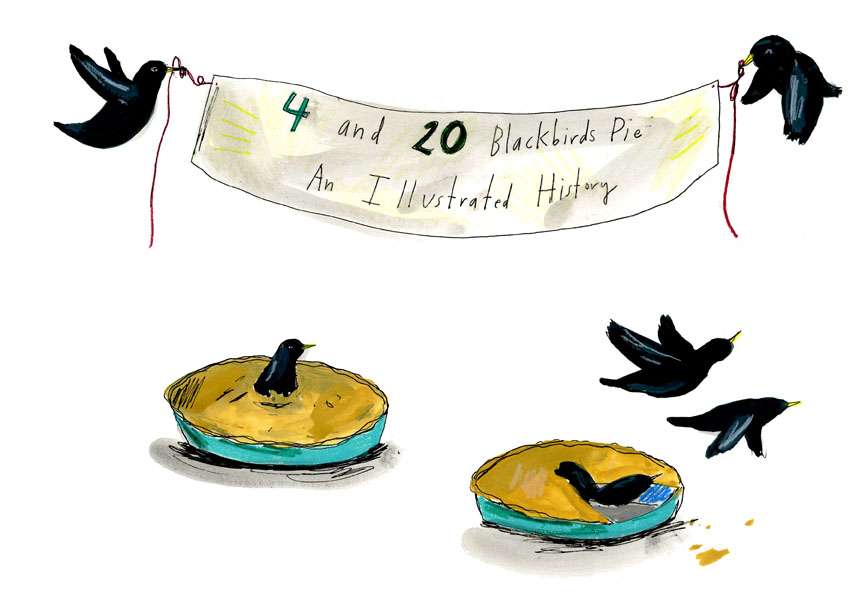
Four and Twenty Blackbirds Pie on The Hairpin!

4 and 20 Blackbirds Pie: An illustrated History

Last month, for National Pie Day (not to be confused with International Pi(e) Day, coming in March), Elizabeth and I had a piece on one of my most favorite sites on the interwebs, The Hairpin! It's an illustrated history of the fabled "4 and 20 Blackbirds Pie" which appears in the Mother Goose rhyme Sing a Song of Sixpence. This piece, which features some of my mose favorite illustrations from Elizabeth yet (those blackbirds!), was also the reason that I made that rather odd Stargazy Quail Pie (so THAT explains it!). You can visit the original post on The Hairpin, and read all the lovely and funny (and spam, unfortunately) comments here, but it's also posted below (though sans comments), in case you don't want your web surfing experience to turn into a "diverting Hurley-Burley".

Though there are a few days that claim to be THE “Day of Pie”-- the U.S. House of Representatives recognized “Pi Day” on March 14th, and a second somewhat dubiously decreed “National Pie Day” on December 1st, according to the American Pie Council, today, January 23rd is the actual “National Pie Day.” It was probably chosen so that people have at least one thing to look forward to after the pie-promises of Thanksgiving and Christmas have faded, and you’re left cold and hungry in the depths of mid-winter.

In honor, of this, we present an illustrated investigation and recipe of the legendary 4 and 20 Blackbirds Pie.

We all know the nursery rhyme, Sing A Song of Sixpence, from the classic Mother Goose. This is the first verse of the rhyme as it first appeared in print in the mid-1700s.

Sing a Song of Sixpence,
A bag full of Rye,
Four and twenty
Naughty boys,
Bak’d in a Pye.

In its subsequent publication in 1780, these additional verses were added and the “naughty boys” were replaced by blackbirds.

When the pie was opened,
The birds began to sing;
Was not that a dainty dish,
To set before the king?

The king was in his counting-house,
Counting out his money;
The queen was in the parlor,
Eating bread and honey.

The maid was in the garden,
Hanging out the clothes;
There came a blackbird
And snapped off her nose.
Four and Twenty Blackbirds Pie: An illustrated History by Emily Hilliard and Elizabeth Graeber
It’s entirely unclear how those twenty-four devious boys all turned themselves into blackbirds, but one cannot know the ways of the devil. We do know that somehow they managed to and are thus transformed for the rest of all history. Though “four and twenty” may seem a random number to us now, it is actually the most frequently appearing number in Mother Goose, representing, perhaps the 24 hours in a day, or a double dozen, 12 being a fabled number in religion and mythology. “A bag full [of Rye]” may have been an actual culinary measurement, like the teaspoon and tablespoon of today. And though there’s no rye mentioned, blackbirds inside a pie could be a reference to this recipe containing live birds, from the 1549 Italian cookbook Epulario or The Italian Banquet by Giovanni de Roselli, translated into English in 1598.

TO MAKE PIE THAT THE BIRDS MAY BE ALIVE IN THEM, AND FLIE OUT WHEN IT IS CUT UP
Make the coffin of a great Pie or pasty. in the bottome whereof make a hole as big as your fist, or bigger if you will. let the sides of the coffin be some what higher then ordinary Pie, which dome. put is full of flower and bake it, and being baked, open the hole in the bottome and take out the flower [flour]. then having a Pie of the bignesse of the hole in the bottome of the coffin aforesaid. you shal put it into the coffin, withall put into the said coffin round about the aforesaid pie as many small live birds as the empty coffin will hold besides the pie aforesaid. And this is to be done at such time as you send the Pie to the table, and set before the guests: where uncovering or cutting up the lid of the great Pie, all the Birds will flie out. which is to the delight and pleasure shew to the company and because they shall not bee altogether mocked, you shall cut open the small pie and in this sort tart you may make many others, the like you may do with a Tart.

This type of surprise pie, or coffin, as they were called, was likely actually made, being related to a genre of Medieval food called solteties, which used illusions in sugar (sound familiar?) and other stunts to impress guests. The live bird pie is later referred to in 1723 by John Nott, cook to the Duke of Bolton, as an antiquated practice with the aim that the birds in flight would extinguish the candles lighting the dining hall and create “a diverting Hurley-Burley amongst the Guests in the Dark”!

Though this sort of wild Hurley-Burley sounds like the makings for a perfect Saturday night, it may not currently be culturally acceptable to insert small life birds into desserts as aforesaid. In lieu of sending you on a wild pigeon chase, here are some ways you can put a bird on it in the modern day:
Illustrated Pie Bird by Elizabeth Graeber
-DO use a pie bird! A ceramic funnel, usually in the shape of a bird, which you insert in the middle of a pie to let steam and juices escape.
Illustrated paper cut-outs for pie
-DO create birds out of paper or modeling clay, attach them to skewers and insert them into the pie.
Illustrated decorated pie crust

-DO cut bird silhouettes out of paper and place them on the pie crust, then dust the entire crust with powdered sugar, letting only the bird shapes remain un-sugared.

-DO (If you dare) make a Stargazy Quail Pie! Recipe here. WARNING: Not for vegetarians or the faint of heart.

-DON’T mold blackbirds out of pie crust dough and bake them in the pie. You will end up with deranged Calvin and Hobbes snowmen-type figures (the 24 naughty boys return!) when the butter melts. Believe me, I’ve tried.

Sources: The Annotated Mother Goose by William Baring-Gould via the American Folklife Center

Wednesday, January 30, 2013

Emily Wallace's Vernacular Pie

Emily Wallace's Vernacular Pie

Hey, cutie pie in the sky, did you check out that "Vernacular Pie" comic in the Indy Week's Pie Issue last month? If not, you don't have to eat humble pie, cause it's right here. Oh, are you too pie-eyed to realize it? Alright. Enough. Sorry. Anyway, my friend Emily Wallace strikes again, here with her clever illustration on pie's role in the parlance of our times. You can catch more of her pie-related comics here and here, and more of her art in general, on the topics of Dollywood, the foods of the North Carolina State Fair, Destiny's (ahem, Testiny's) Child, and much more, right over here.

Wednesday, January 16, 2013

Stargazy Quail Pie

Stargazy Quail Pie | Nothing in the House

Consider this more of a historical experiment than a culinary one. But don't get me wrong, it was indeed a culinary EXPERIMENT--my first time cooking quail, and a somewhat rare occurrence of cooking meat; I'm just not sure how much I can endorse this as an enjoyable pie to eat. But I've deemed 2013 the year of the savory pie, so I guess there was no other way to start but to dive right in...

I initially set out to make a "modernized" version of 4 and 20 Blackbirds Pie from the Mother Goose nursery rhyme (more on that soon here!). Since it would be rather difficult and probably not culturally acceptable to catch small live birds and stuff them inside a pie, I decided instead, well, to use dead ones. Some suggested cornish game hens and others suggested quail, so after doing a little research in a few cookbooks and on the ol' internet, I found two recipes-- one for a Medieval Game Pot Pie from Alton Brown and another for Stargazing Quail Pie from the British Pieminister Cookbook. Both require stuffing whole birds and baking them in a crust, their little legs poking through. Eeeep!

Stargazy Quail Pie | Nothing in the House

Stargazy Pie is a Cornish dish, traditionally made with pilchards, or sardines. Their heads are baked sticking out of the crust, giving the appearance that they're gazing at the sky, but this practice also allows the oils and juices from the fish to flow back into the pie, making it moist. The pie originates from the small fishing village of Mousehole in Cornwall and is usually served on Tom Bawcock's Eve, celebration the heroics of fisherman it's named after. The story, dating back to the 16th century, goes that one Christmas the town was nearing starvation, as storms had been raging on the coast, grounding all the fishing boats. On December 23rd, the brave Bawcock ventured out to see, scored a catch, and made it safely home, thus saving Christmas and the entire village population. The whole catch, which included 7 different types of fish, was then said to have been baked into a pie. As I child, I remember reading about this story in the children's book The Mousehole Cat.

Along with the usual fish, stargazy pie is a hearty affair, generally containing heaps of onions and potatoes. I ended up combining the two recipes I found, using quail, but instead of opting for the Middle Eastern-inspired filling that Pieminister uses, I made an adapted version of Alton Brown's dried fruit stuffing for more of a mincepie flair. In the end, the flavor was great, but I honestly had a bit of a mental block--the tininess of the quail made me a little uncomfortable, as did their little legs sticking out of the crust (more crustgazy than stargazy)! Like I said, this was more of a historical exercise than a culinary one--it did make me think why some recipes persist and some fall out of favor. It didn't suit my taste, but perhaps those less squeamish than me will just eat this up.

Stargazy Quail Pie | Nothing in the House

Stargazy Quail Pie
An amalgamation of recipes by Pieminister and Alton Brown

Ingredients
Nothing-in-the-House pie crust
4 Tblsp. olive oil
1 large onion, diced
3 garlic cloves, minced
6 oz. mixed dried fruit (apricots, figs, and crystalized ginger)
1/4 c. pine nuts, lightly toasted
1 small bunch of thyme, leaves picked and chopped
1/4 tsp. allspice
1/4 tsp. cumin
1/4 tsp. paprika
zest of 1 lemon
2 Tblsp. lemon juice
1/4 tsp. black pepper
1/4 tsp. sea salt
1 1/2 Tblsp. unsalted butter
4 quails (defrosted, if frozen)
sea salt

Directions
1. Prepare the Nothing-in-the-House pie crust as per the directions. Chill dough at least 1 hour. Once chilled, roll out 1/2 of pie crust and fit into a 8 or 9-inch greased and floured deep casserole dish. You can choose to roll out the top-crust now and refrigerate it flat, or roll it out once you've prepared the filling. Either way, you should put both the remaining crust and the pie pan in the fridge while you prepare the filling.

2. Preheat oven to 350 degrees F. Heat 2 Tblsp. olive oil in a pan, add the onion and garlic and cook over very low heat 15-20 minutes until onions are translucent and golden. Transfer to a medium-sized bowl and add dried fruit, pine nuts, thyme, spices, and lemon zest and juice. Season with salt and pepper and set aside.

3. Heat remaining 2 Tblsp. olive oil and butter in a frying pan or skillet large enough to hold the quails. Rinse birds, then place them in the pan and season them with salt and pepper. Fry for about 5 minutes on each side until golden. Remove them from the heat and stuff loosely with filling.  

4. Put remaining filling into the bottom of the pie crust and make 4 spaces to hold the quails. Put them in so that their legs are sticking up and arrange the filling around them so they stay upright.  Roll out the other crust half if you haven't already. Cut 4 slits in the crust for the quail legs and place on top of the pie. Pull legs through and flute crust to seal. Brush with an egg wash and bake for 40-45 minutes until the crust is golden and the birds are cooked through. Serves 4.

Tuesday, December 25, 2012

Eating A Christmas Pie

Jack Horner Eating A Christmas Pie

Merry Christmas, one and all! For the second year in a row, a Jack Horner Christmas pie post. Though this common nursery rhyme was first published in 1725, this image comes from William Wallace Denslow's Mother Goose, c. 1902. Whether your Christmas pie contains plums or not, I hope you have plenty, and that you don't have to sit in a corner to eat it (unless you have some magical cozy corner full of friends and family and stocked well with pie). From the Nothing-in-the-House kitchen to yours, much love and happiness, music and food to all of you this holiday season. 

Thursday, October 18, 2012

"I LIKE PIES!" A historical comic by Ellen Lindner

Nell Brinkley and Evelyn Thaw cartoon in Bitch Magazine

A few months ago my housemate Bobbie handed me a copy of Bitch Magazine, open to a cartoon. "Check this out--it's about pies," she said. It clearly was, given the big block letters reading "I LIKE PIES" across the bottom of the comic, but it also depicted the meeting of two prominent women of the 20th century--the cartoonist Nell Brinkley, and Evelyn Thaw, née Nesbit, the wife of tycoon Harry Thaw, who was on trial for the death of architect Stanford White (who by the way, designed the addition to Rokeby). The two women met in 1908 at the New York City Jail--Nell, who drew for the Hearst newspapers, was charged with doing a story about Evelyn, who had been told by her lawyers to win the court's sympathy. When Nell asked her to talk about things she liked, rather than her misfortune, Evelyn responded, "I love oysters Rockefeller, teal on toast, baked Alaska, but most of all "I like pies!" That quote appeared as the headline on the next day's paper, and Nell's coverage of the Thaw trial made her famous. Evelyn, however, was sadly left destitute when her husband was declared insane.

That cartoon on the back cover of Bitch, was drawn by the talented cartoonist Ellen Lindner. I tracked her down via the magic of the interwebs, and asked if I might feature it on the pie blog. In giving her permission, she shared a few other tidbits about her research and drawing process. Ellen first came upon the work of Nell Brinkley when she was working on a piece for Paul Gravett's 1001 Comics to Read Before You Die. In regards to Nell, Ellen says, "She's a massive heroine of mine--someone who took on the big boys of the cartooning world back when it was a bit odd for women to be working, let alone splashing their names all over the country's newspapers." 

Ellen conducted the research for this story at the New York Public Library's Picture Collection in Mid-Manhattan, and has some additional sketches for the piece on her blog. I recommend you take a look at more of Ellen's work on her website, and check out her periodical The Strumpet (and their Kickstarter for pre-orders...only 4 more days to go!), "a words and pictures periodical uniting lady comix stars of the future...in one cartoony package." COOL! I'm glad that I got united with this present-day lady comix star though a lady comix star of the past...and pie.

Friday, June 08, 2012

All Around the Mulberry Tree


It was a big week for me and my writerly pursuits. Both pieces I have been working on came out within two days of each other. The first one, for The Hairpin, was a quippy real-life rom-com about dating a Civil War reenactor. Aside from a hardtack reference and a somewhat era-appropriate supper description, it really has nothing to do with food. The second though, "The Mulberry's the Worst Berry There Ever Was" for Gilt Taste (with its wonder editor Francis Lam), is an ode to the little pesky berry that launched this whole pie making obsession and is essentially responsible for the existence of this here blog.

As I've talked a bit about before in Why I Like Pie, and as you'll read in the Gilt Taste piece, I started baking pies the summer after graduating college. I was discovering all these mulberry trees (and some black raspberry bushes) all over Ann Arbor, and used the free fruit to fill as many pies as I could make, often with other gal pals baking right along side me. When I moved to Vermont after that summer, my friend Margaret suggested we start a pie blog so we could still stay in touch via our baking endeavors. Et puis, voila.

I had such a nostalgia for mulberries, that it wasn't until I heard this recording, from the Coal River Project of the American Folklife Center (after scouring the Library of Congress archive for "mulberry" content) that I started to question their merits. Despite their drawbacks though, my feelings for the fruit remain, as do all the things that the mulberry set in motion. Here's a little musical ode to it that I came across in that mulberry search. It's a little torchy and a little cheesy, but somehow that feels right.

Friday, May 25, 2012

Braceros' Cafeteria Pie


This photo, of women cooks/bakers preparing to serve pie to Mexican workers in Hood River County, Oregon, c. 1943, comes to us by way of the Oregon State University Archives. According to the Archive, almost the entire work force of international migrant workers at that time was composed of over 15,000 young Mexican nationals, who came to the U.S. via the Bracero Program, a WWII era labor initiative between the United States and Mexico. The Braceros, as they were called, were employed on farms and orchards where there were critical labor shortages due to the war. Many faced poor living conditions and suffered from labor disputes and lack of interpreters. When American men returned from the war after 1945, most of these workers lost their jobs and were deported to Mexico. Though Braceros essentially saved American agriculture during WWII, they are generally not recognized for their labor and contribution.

Just as I'm curious about the lives of the Braceros, in particular their songs, traditions, and other labor lore, I also wonder who the women in the above photo were--Wives and daughters of Bracero camp managers? Single mothers in need of work? What was there their own work culture, in juxtaposition to those of the Braceros, and what might have been the intersection between those two worlds of Mexican laborers and American women whose husbands or brothers were away at war? And also importantly, what kind of pie is that? Apple, peach, or pear with fruit from the orchard, perhaps?

You can see more photos of the series here (though none others contain pie) and read more about the Braceros via Oregon Public Broadcasting here. Also check out Woody Guthrie's song Deportee, which was written about the 1948 death of 28 Braceros who were being deported back to Mexico.

Thursday, May 03, 2012

The Preacher and the Slave (Pie In The Sky)


What with May Day, Pete Seeger's birthday today (which is really the reason for my post--Happy 93rd Pete!), and this book I've been reading about labor-lorist Archie Green, I've been thinking a lot lately about labor movements in history. On May Day proper I attended the American Folklife Center Botkin lecture given by the author of said book, Sean Burns. There I saw my old bosses engage in inspiring discussion about folklore history, the Wobblies, and Archie and Pete's differing opinions on "folk songs" vs. "people's songs" vs. "worker songs". It seems that in Archie's eyes, even Pete was co-opting and commercializing these Wobbly songs songs a little too much.

One of the songs in question was the "Preacher and the Slave," written by Wobbly Joe Hill in 1919 and included in the Little Red Songbook. It was a parody of the Salvation Army (which the Wobblies referred to as the "Starvation Army") adopted hymn "In The Sweet By And By" and also coined the phrase "pie in the sky," as a critique of the Salvation Army and their focus on saving souls rather than on the living conditions and rights of hungry workers.

And just to follow that trajectory a bit, the phrase and concept of "pie in the sky" reappears in many subsequent protest songs and writings. A perhaps unexpected example can be found in the title track of Jimmy Cliff's The Harder They Come, which very loosely (and I mean very loosely) deals with the oppression of the poor in Jamaica. "They tell me of the pie up in the sky, waiting for me when I die, but between the day you're born and when you die, you know they never seem to hear even your cry."


The main point of both is one that I can really get down with--instead of a pie up in the sky, why not some pie right here, right now? I hope Pete is enjoying some today.

Wednesday, March 07, 2012

Pie & Doughnuts for Woodsmen and You

A few weeks ago, I was scouring the Library of Congress Print & Photograph Online Catalog for work. I was looking for images of western culture and song--mostly cowboys and Texas fiddling and pow-wow drum, but I was having so much fun looking at those old photographs that I decided to put in a few search terms that were of a more personal interest, namely "pie" and "doughnuts" (another baked good favorite). The search yielded exciting results--historical images of a little girl feeding doughnuts to a bear cub, national doughnut queens and pie contests and socials. One group of photos combined these two queries--a collection of images by John Collier from May 1943 of Maine loggers and woodsman on a Spring pulpwood drive on the Brown Company timber holdings.


According to the photos' captions, the woodsmen ate four meals per day, with the two "lunches" at 10am and 2pm served "on location", cafeteria style into individual pie tins. Desserts included "several kinds of cookies, gingerbread, doughnuts, and two kinds of pie." Hmm... that dessert menu sounds familiar... Maybe we should start serving our doughnuts out of barrels too.


In the above picture, "Cookie" the cook's assistant is dishing out pie at the mid-morning lunch near where the men are working. Below, a woodsmen enters the Pie Enjoyment Zone during his mid-afternoon "lunch" by Long Pond. On the menu that day: roast pork and dressing, boiled potatoes, turnips, baked beans, hot cakes, hot biscuits, bread, butter, cookies, apple pie, orange pie, milk, tea, coffee, and water. These men must have been working hard. I also wonder what that orange pie was all about?


Based on the limited knowledge I have of New England foodways, mainly from folklore and literature (I'm thinking of Sarah Orne Jewett's The Country of the Pointed Firs, which is full of both doughnuts and pies!), pie and doughnuts were traditional rural foods, consumed for both dessert and for breakfast. I wonder when and where doughnuts became more of a standard breakfast item than a dessert?

This whole post wasn't just an excuse for me to use the pie blog plug my friend Amy's donut zine release party tonight, but I'll let these Maine woodsmen's pie-and-doughnut pairing serve as one. If you're in DC tonight and want to learn more about and of course, eat some doughnuts (some even filled with pie filling!), make your way over to the Velvet Lounge at 8pm for "Donut Go There" A Zine Release Party. Tarts by Tarts will be contributing some special edition doughnuts to the doughnut buffet, my friend Pete will deliver a west coast doughnut scene report, Amy will be speaking, bands are playing, I'll be performing this little doughnut ditty, and you can get your hands on one of these zines, free with admission. There wont be pie, but who doesn't love doughnuts?

Tuesday, February 14, 2012

Vintage Pie-Themed Valentines

Still not sure what to do for Valentine's day? Doughn't pie-ne away! What's butter than getting some "flours" and whipping up somethin' sweet--whether for your special someone, that crush you've got your eye on, or alone on the couch in a union suit, Joan Didion's The Year of Magical Thinking, and a bottle of cheap wine (been there). Might we suggest a dark chocolate & salted caramel pie? salty honey? or lemon meringue? And lord knows, if there's one thing I like more than pie, it's puns. Pair that pie with some of these punny vintage Valentines, and you'll be sure to get things rollin'...


The last Valentine comes from the Montana Historical Society and was delivered to a young resident of Ollie, MT in approximately 1930. Happy hearts 'n' tarts!

Wednesday, January 25, 2012

Monroe's Patent Pie Meat


I've been getting back into meat-eating in 2012, but I'm not sure I'd be ready for Monroe's pie meat yet (or ever)! Circa 1869 wood engraving from the Library of Congress Prints and Photographs Online Catalog.

Thursday, January 12, 2012

Pie Class at Mary Washington


Two pies a piece at the University of Mary Washington in Fredericksburg, Virginia! From the UMW Centennial archives flickr.

Saturday, December 24, 2011

May Your Christmas Pie Be As Full Of Plums

Little Jack Horner in the Christmas PEZ
There are no plums planned for Christmas pies here in the Nothing-in-the-House kitchen, but the sentiment still stands. Last night, for a music holiday party at my parents' I made a Shaker clementine pie, a salty honey pie (upon my dad's request) and collaborated on a green tomato pie with my dad. For Christmas dinner tomorrow, I'm making my grandma Eileen's lemon meringue pie, and perhaps another. 

What will your Christmas pie be full of? Whatever it is, I hope it is as full of that as Jack Horner's is of plums.

Cranberry Chess Pie

Fig Pistachio Tarte Tatin

Peppermint Pattie Tart

Whiskey & Dark Chocolate Bundt Cake

Blog Archive